




What is the new “Super RIGI”?:
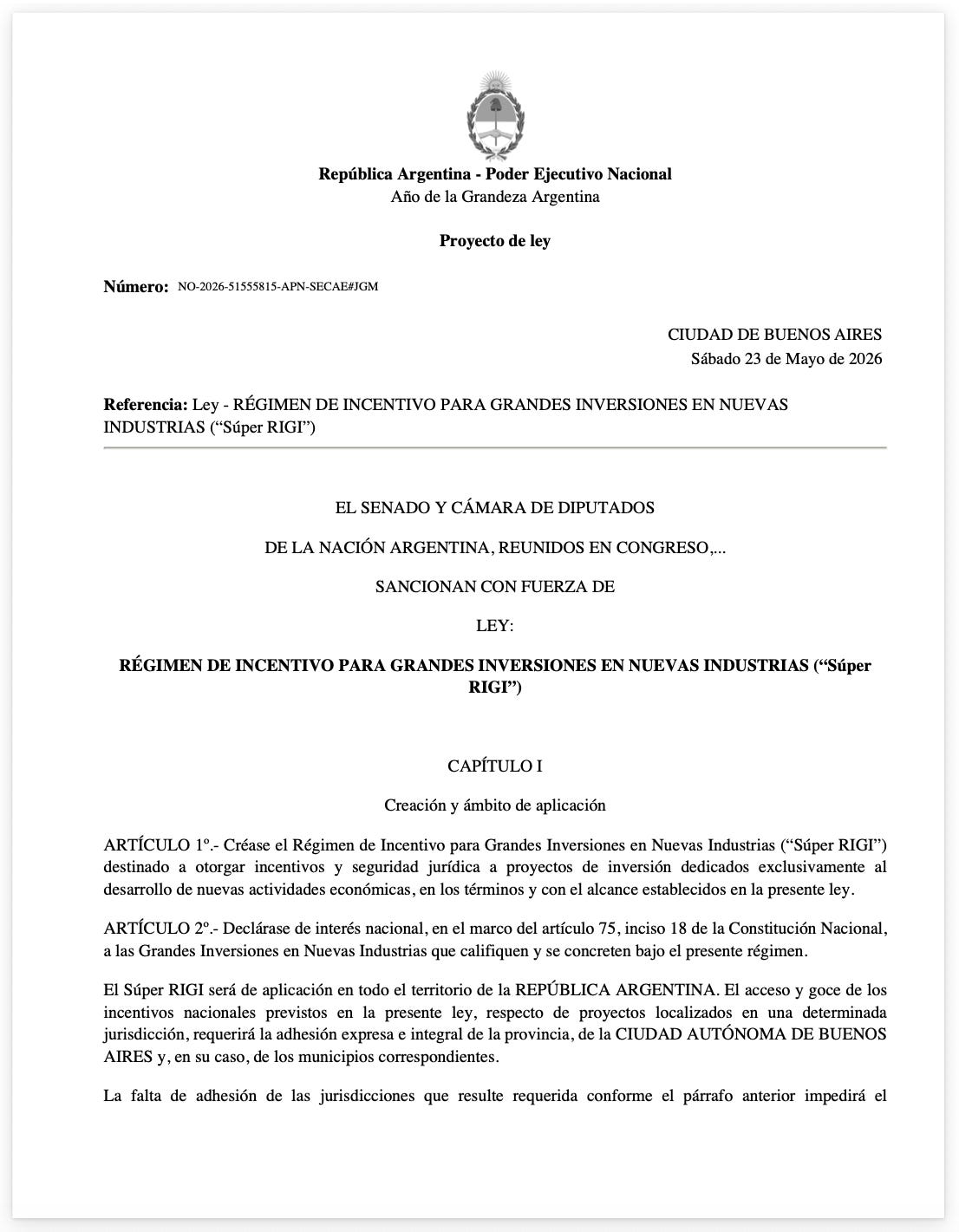
Argentina’s executive branch submitted a draft law to the Chamber of Deputies (the equivalent of the U.S. House of Representatives) establishing the Régimen de Incentivo para Grandes Inversiones en Nuevas Industrias (“Super RIGI”) for legislative debate and approval.
Signed by President Javier Milei, Economy Minister Luis Caputo, and Cabinet Chief Manuel Adorni on May 22–23, 2026, the bill is the third legislative package Milei has sent to Congress since the start of the ordinary session period. This draft bill is an upgrade of the original RIGI mechanism first enacted as part of the Ley Bases (omnibus bill), but limited exclusively to genuinely new industries, which either do not currently exist in Argentina or are in experimental or pilot stage. If an investor ran a project under the original RIGI, they are out of this new regime.
The draft law defines eligible industries broadly.[1] The executive, on the other hand, signaled AI, semiconductors, advanced biotechnology, and digital infrastructure as paradigmatic targets in the transmittal message, and Caputo has separately indicated additional priority sectors in press communications that carry no statutory weight.[2] The new regime is not available for the expansion, modernization, or reconversion of existing facilities.[3] Only greenfield projects will be considered.[4][5]
Who Can Apply
Applications open FIVE years from the date the implementing regulations take effect,[6] with a single possible ONE-year extension by executive decree. Eligible parties must constitute a Vehículo de Proyecto Único (VPU)—a special purpose vehicle with a single object and assets dedicated exclusively to the project.[7] The structures permitted include Argentine corporations (S.A., S.A.U., S.R.L.),[8] branches of foreign companies registered under Article 118 of the General Corporations Law,[9] joint ventures (JV),[10] and other associative contracts.[11]
For U.S. investors, the branch route and the JV structure may be the most efficient entry points.
Disqualifying conditions include: anti-corruption convictions confirmed at the second instance level under Law 27.401 (Argentina’s corporate criminal liability statute, perhaps the closest domestic analog to the FCPA),[12] tax or customs violations confirmed on appeal, outstanding firm tax debts, and bankruptcy,[13] or Director/officer-level convictions within corporate structures.[14]
Any overlap with a pending original RIGI application—including via related parties sharing more than 50% of CAPEX, physical assets, or production capacity—also disqualifies the prospective investor. The regime is designed to be hermetically separate from its predecessor.
Investment Threshold
Minimum qualifying investment: USD 1 billion in computable assets per project.[15] Real estate can count for no more than 15% of that threshold.[16] Within the first two years from the Adhesion Date, the investor must commit at least 20% of the total minimum, or USD 200 million, in computable assets.[17][18] Financial assets and inventory are excluded from computation.
The Adhesion Date is the date the approving administrative act is notified to the VPU, and from that date the investor’s rights vest as an acquired right with property-level protection.[19][20]
The application process is documented and exhaustive: investors must submit (a) project description, (b) corporate data, (c) investment schedule, (d) a sworn technical declaration that the activity is genuinely new in Argentina, (e) a sworn statement that the project will not distort the local market, (f) an independent economic-financial feasibility report, (g) a technical feasibility report, and (h) a foreign exchange balance demonstrating the project will not generate net foreign currency demand.[21][22]

The reviewing authority has 90 business days to approve or reject.[23] Rejection cannot be appealed but the project may be resubmitted up to twice within the same calendar year.[24] There is also a requirement of mandatory self-reporting of foreseeable non-compliance within 10 business days.[25]
Tax Package
Corporate income tax is fixed at 15%, against Argentina’s standard rate of 25%.[26][27]
Accelerated depreciation applies: movable assets can be fully amortized in TWO years; infrastructure investments can be written off 60% in the year of commissioning and 40% over the following TWO years.[28] Loss carryforwards are unlimited in time—and after FIVE years without absorption, they can be transferred to third parties, which opens a secondary market for tax attributes.[29][30][31] The bank debit and credit tax is 100% creditable against income tax.[32] Likewise, the draft treats all income tax calculations as fully IPC-indexed for VPUs,[33] which will enter into conflict with the restriction in Article 93 of the general Income Tax Law.[34] The latter is a protection that may be critical in Argentina’s inflation context.
On distributions: dividends and profit remittances are taxed at 7% for the first FOUR years post-Adhesion, dropping to 3.5% thereafter.[35][36]
Import and export duties: there is a full exemption for capital goods and inputs forming part of the approved investment plan, and full export duty exemption for products generated by the project.[37][38][39] This is categorical and non-waivable by any subsequent regulation.[40]
One notable item for international investors: Article 45 contains a carve-out for the OECD/G20 Pillar Two global minimum tax.[41][42] To the extent Argentina’s 15% rate would trigger a top-up tax in the investor’s home jurisdiction under Pillar Two income inclusion rules, the Argentine incentive will not apply, thus preventing Argentina’s benefit from simply being transferred to a foreign treasury. For U.S. investors whose parent companies may be subject to GILTI or future Pillar Two frameworks, this provision may require careful tax structuring at the outset.[43][44]
FX and Capital Controls
The Super RIGI offers a staged currency liberalization locked in contractually.
Export proceeds from the project are exempt from the obligation to repatriate and liquidate in the exchange market on a graduating scale—20% free from year one of first export, 40% from year two, 100% from year three.[45] Capital contributions, external financing, and service payments face no repatriation or liquidation obligation at all.[46] Dividend remittances are freely accessible to the exchange market without prior BCRA approval, provided the underlying investment entered through the exchange market.[47]
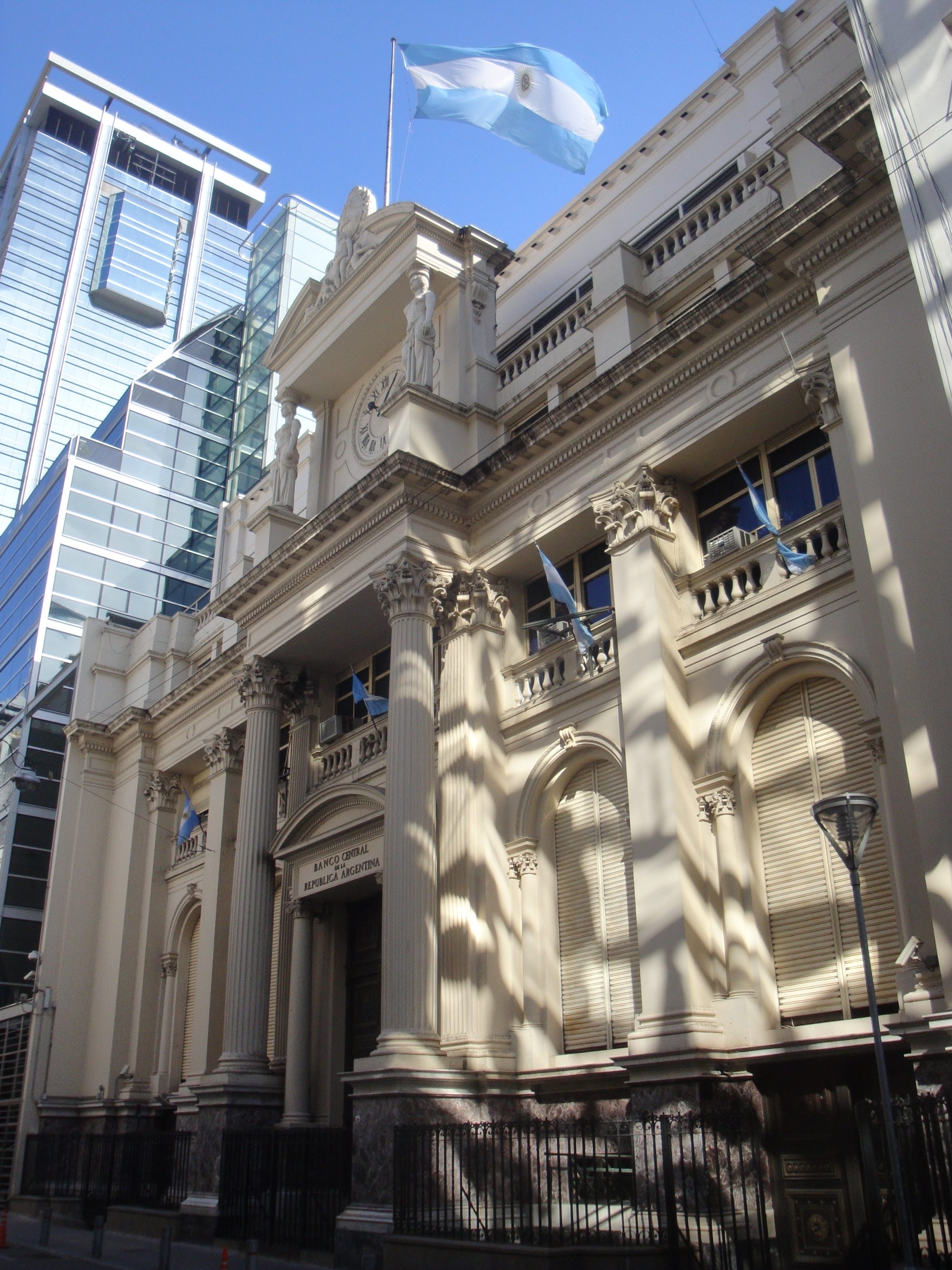
All of the above is stabilized for 30 years from the Adhesion Date.[48] If a future Argentine government imposes controls more restrictive than those in place at Adhesion, the VPU may reject their application by presenting its adherence certificate.[49] The burden shifts to BCRA to prove no violation occurred before any summons proceeding commences.[50][51][52][53]
Dispute Resolution and Treaty Interface
Chapter XI of the draft regulates jurisdiction and arbitration. It explicitly allows disputes between the Argentine State and VPUs to be resolved through international arbitration after a 60-day amicable negotiation period.[54][55] Most importantly, it provides that the rights and incentives acquired under the Super RIGI “shall be considered protected investments” within the meaning of Argentina’s Bilateral Investment Treaties (BITs).[56] This includes the 1991 U.S.-Argentina Treaty on the Promotion and Protection of Reciprocal Investments, which provides for ICSID arbitration and investor-state dispute settlement. Thus, U.S. investors benefit from treaty-level protection for their Super RIGI rights from the moment of adhesion.
Provincial Adhesion: The Federal Variable Within Argentina
The regime is national in scope but requires express provincial adhesion for any project located in a given province. A province that does not adhere cannot host a Super RIGI project, as its residents will not be able to access the national incentives. Provinces that adhere must also restrain their own fiscal demands: any local norm that limits, restricts, or interferes with Super RIGI rights and incentives is declared null and void from inception.[57]
The provinces most likely to adhere quickly may be those with existing tech infrastructure, administrative capacity, and political alignment with the Milei agenda: the City of Buenos Aires (CABA), Córdoba, Mendoza, and Neuquén. The last two are particularly relevant for mining-processing projects and energy-adjacent tech respectively. Provinces that are politically distant from La Libertad Avanza, heavily dependent on Ingresos Brutos revenues (provincial gross turnover tax) from industry, or in active budget negotiations with the national government—Chaco, Formosa, perhaps Santa Cruz in the near term—are the least likely to adhere without significant political pressure or fiscal compensation.

Compliance Considerations for U.S. Investors
The disqualification provisions of Article 8 are directly compatible with FCPA pre-investment due diligence requirements: conviction under Law 27.401 disqualifies a VPU at the membership level, including directors and officers.[58][59][60] This means a U.S. company investing via a VPU has a built-in incentive to conduct FCPA-grade screening of all Argentine participants, since a local partner’s corruption conviction—even unrelated to the project—can terminate the regime’s benefits retroactively.
The transfer pricing provisions of Article 42 require arm’s length pricing for all intra-group transactions, which is consistent with both OECD standards and IRS Section 482 expectations.[61][62] Cost-sharing agreements are explicitly subject to arm’s length standards. This is favorable for compliance: the new regime does not create opportunities to shift income through non-arm’s-length structures without regulatory scrutiny.
For SEC reporting purposes, a USD 1 billion minimum investment by a U.S. issuer is likely material and requires disclosure as a capital expenditure commitment in Forms 10-K and 10-Q.[63] The 30-year stabilization commitment may also require disclosure as a risk factor, given the possibility that a future Argentine government or court may not honor it.[64]
Anti-money laundering (AML) exposure is concentrated at the FX layer: the free disposition of export proceeds and the absence of repatriation obligations for capital accounts create conditions where additional know-your-transaction monitoring will be required, particularly where financing chains involve multiple intermediate jurisdictions.[65][66][67]
A Brief Political Analysis of Super RIGI’s Chances to be Passed Into Law
The Super RIGI arrived in Congress yesterday under mixed conditions for its passage. The Milei administration does not hold majority in either the Chamber of Deputies or the Senate. The original RIGI passed via Ley Bases only after extended and contentious negotiations with provincial blocs and centrist opposition. The new submission occurs in a period of internal tension within the ruling coalition, with disputes between Santiago Caputo[68] and Martín Menem, and reputational damage from the Adorni patrimony case.
The government has begun negotiating directly with governors to secure approval, framing the Super RIGI as a vehicle for provincial development—mining-processing, AI infrastructure, energy tech—in jurisdictions that feel excluded from Argentina’s existing investment map. That negotiation process may prove critical to the passage of the draft into law. Governors who adhere get projects; governors who don’t adhere do not. That political leverage may be exerted in order to obtain compliance from the Provinces to a certain extent.
The opposition will likely contest the fiscal cost of the tax incentives, the loss of Ingresos Brutos revenue for adhering provinces, and the scope of the export duty exemption. These are legitimate technical objections, not ideological ones, and they may be negotiable.

However, the real concern is not congressional opposition per se. Rather, the pitfalls of passage may manifest in the internal discipline of La Libertad Avanza’s coalition, which has shown periodic fractures under legislative pressure. The government’s decision to bundle the Super RIGI with three other politically lower-controversy bills (lobbying regulation, gambling addiction, front-of-package labeling) is a deliberate packaging strategy: it creates a legislative vehicle where opposition can extract concessions on the other bills in exchange for movement on the Super RIGI, rather than forcing an isolated vote on a USD 1 billion investment threshold that plays poorly in a country with nearly 40% of its citizens below the poverty line.
Passage may remain more likely than not for now, but not within a timeline of weeks. It is possible, however, that the negotiation with governors may determine the timeline more than the floor debate itself. Provinces that adhere before passage—which the law permits in anticipation—could give the government some political momentum.
If three or four economically significant provinces declare adhesion before the congressional vote, the remaining opposition may become harder to sustain. It would not be unreasonable to watch for early adhesion signals from CABA and Córdoba as the leading indicators of the new regime’s viability.
See The Southern Trade on Google
Want The Southern Trade analysis at the top of your feed? You can tell Google to prioritize this source by clicking on the button below.
What to Read Next:


ST Monitor | May 2026 | Resources Realignment Under Political and Market Pressures in Latin America



© 2026 Manuel Reyes, The Southern Trade Group™. All rights reserved. Content may not be reproduced without permission.
Legal and Investment Disclaimer
This document is provided for informational and educational purposes only. Although it discusses legal frameworks, regulatory structures, and investment-related considerations, it does not constitute legal advice, tax advice, financial advice, or investment advice of any kind.
Nothing in this guide is intended to create, and receipt of it does not constitute, an attorney-client relationship, advisory relationship, or any other form of professional engagement between the author and the reader. The content reflects a general overview and may not address specific facts, circumstances, or applicable laws relevant to any particular situation.
Readers should not act or refrain from acting based on any information contained herein without seeking independent advice from qualified legal, tax, and financial professionals licensed in the relevant jurisdictions.
This document does not constitute an offer to sell, a solicitation of an offer to buy, or a recommendation to purchase, sell, or otherwise trade any securities, financial instruments, or assets. Any references to investment structures, jurisdictions, or regulatory regimes are illustrative only and should not be interpreted as endorsements or recommendations.
The author makes no representations or warranties, express or implied, regarding the accuracy, completeness, or timeliness of the information contained herein. Laws, regulations, and policies may change, and their application can vary widely based on specific circumstances.
To the fullest extent permitted by law, the author disclaim any liability for any loss or damage arising directly or indirectly from reliance on this document or its contents.
REFERENCES LIST
[1] Art. 4, RÉGIMEN DE INCENTIVO PARA GRANDES INVERSIONES EN NUEVAS INDUSTRIAS (“Súper RIGI”), https://www.parlamentario.com/wp-content/uploads/2026/05/0005-PE-2026.pdf.
[2] Martin Oliver, Argentina’s Super RIGI: Eight Energy and Mining Sectors in Scope, Formal Text Still Pending, Shale24, https://www.shale24.com/en/oil-and-gas/argentinas-super-rigi-eight-energy-and-mining-sectors-in-scope-formal-text-still-pending-n1147.
[3] Art. 4, supra note 1, (Final Paragraph).
[4] Art. 1, Id.
[5] Art. 8, Id.
[6] Art. 5, Id.
[7] Art. 6, Id.
[8] Art. 7 (a), Id.
[9] Art. 7 (b), Id.
[10] Art. 7 (c), Id.
[11] Art. 7 (d), Id.
[12] Art. 8 (a), Id.
[13] Art. 8 (b), Id.
[14] Art. 8 (e), Id.
[15] Art. 12 (a), Id.
[16] Art. 14, Id.
[17] Art. 12 (b), Id.
[18] Art. 13, Id.
[19] Art. 22, Id.
[20] Art. 24, Id.
[21] Art. 15, Id.
[22] Art. 16, Id.
[23] Art. 17, Id.
[24] Art. 19, Id., (last paragraph).
[25] Art. 29, Id.
[26] Art. 33 Id. (may displace Art. 73 of Argentina’s Tax Law – N° 20628).
[27] Contra, Art. 73, Ley de Impuesto a Las Ganancias, https://biblioteca.afip.gob.ar/dcp/LEY_C_020628_2019_12_05.
[28] Art. 34, supra note 1.
[29] Art. 35, Id.
[30] Art. 36, Id.
[31] Art. 37, Id.
[32] Art. 51, Id.
[33] Art. 38, Id.
[34] See also, Art. 93, supra note 27.
[35] Art. 39, supra note 1.
[36] Art. 40, Id.
[37] Art. 52, Id.
[38] Art. 53, Id.
[39] Art. 54, Id.
[40] Art. 55, Id.
[41] Art. 45, Id.
[42] Cf., OECD, Global Anti-Base Erosion Model Rules (Pillar Two), https://www.oecd.org/en/topics/sub-issues/global-minimum-tax/global-anti-base-erosion-model-rules-pillar-two.html#rules.
[43] 26 USC §951A, Tax Cuts and Jobs Act of 2017 (TCJA), https://uscode.house.gov/view.xhtml?req=granuleid:USC-2023-title26-section951A&num=0&edition=2023.
[44] See also, Internal Revenue Service (IRS), Concepts of Global Intangible Low-Taxed Income Under IRC 951A, https://www.irs.gov/pub/fatca/int_practice_units/global_intangible_low_taxed_income.pdf.
[45] Art. 60, supra note 1.
[46] Art. 61, Id.
[47] Art. 70, Id.
[48] Art. 74, Id.
[49] Art. 84 (a), Id.
[50] Art. 83, Id.
[51] Art. 84, Id.
[52] Art. 85, Id.
[53] Art. 86, Id.
[54] Art. 108, Id.
[55] Art. 109, Id.
[56] Art. 110, Id.
[57] Art. 112, Id.
[58] Art. 8 (a), Id.
[59] Ley 27401 de Responsabilidad Penal, https://www.argentina.gob.ar/normativa/nacional/ley-27401-296846/texto.
[60] 15 USC 78dd-1, Foreign Corrupt Practices Act of 1977 (FCPA), https://uscode.house.gov/view.xhtml?req=(title:15%20section:78dd-1%20edition:prelim)%20OR%20(granuleid:USC-prelim-title15-section78dd-1)&f=treesort&edition=prelim&num=0&jumpTo=true.
[61] Art. 42, supra note 1.
[62] US Tax Statute (26 U.S.C. § 482), https://uscode.house.gov/view.xhtml?req=(title:26%20section:482%20edition:prelim).
[63] 17 CFR 229.303, 17 CFR Part 229 — Standard Instructions for Filing Forms Under Securities Act of 1933, Securities Exchange Act of 1934 and Energy Policy and Conservation Act of 1975 — Regulation S-K., https://www.ecfr.gov/current/title-17/section-229.303.
[64] 17 CFR 229.105, 17 CFR Part 229 — Standard Instructions for Filing Forms Under Securities Act of 1933, Securities Exchange Act of 1934 and Energy Policy and Conservation Act of 1975 — Regulation S-K., https://www.ecfr.gov/current/title-17/section-229.105.
[65] Art. 61, supra note 1.
[66] Art. 62, Id.
[67] Art. 66, Id.
[68] Advisor to the President Santiago Luis Caputo. Not to be confused with his cousin, Minister of Economy Luis Caputo.