




On June 24 the lower chamber of Argentina’s bicameral Congress passed the Super RIGI with half-sanction (or media sanción) by 130 votes to 106, with seven abstentions. A half-sanction does not make the Super RIGI into law.
Under Argentina’s bicameral system, both chambers of Congress have to approve draft legislation. The bill now moves to the Senate, and no Vehículo de Proyecto Único (VPU) can be constituted under the Super RIGI until the Senate votes in favor, the law is promulgated, and the Executive issues the implementing regulation. Under the proposed law, eligible parties must constitute a VPU, a special purpose vehicle with a single object and assets dedicated exclusively to the project.
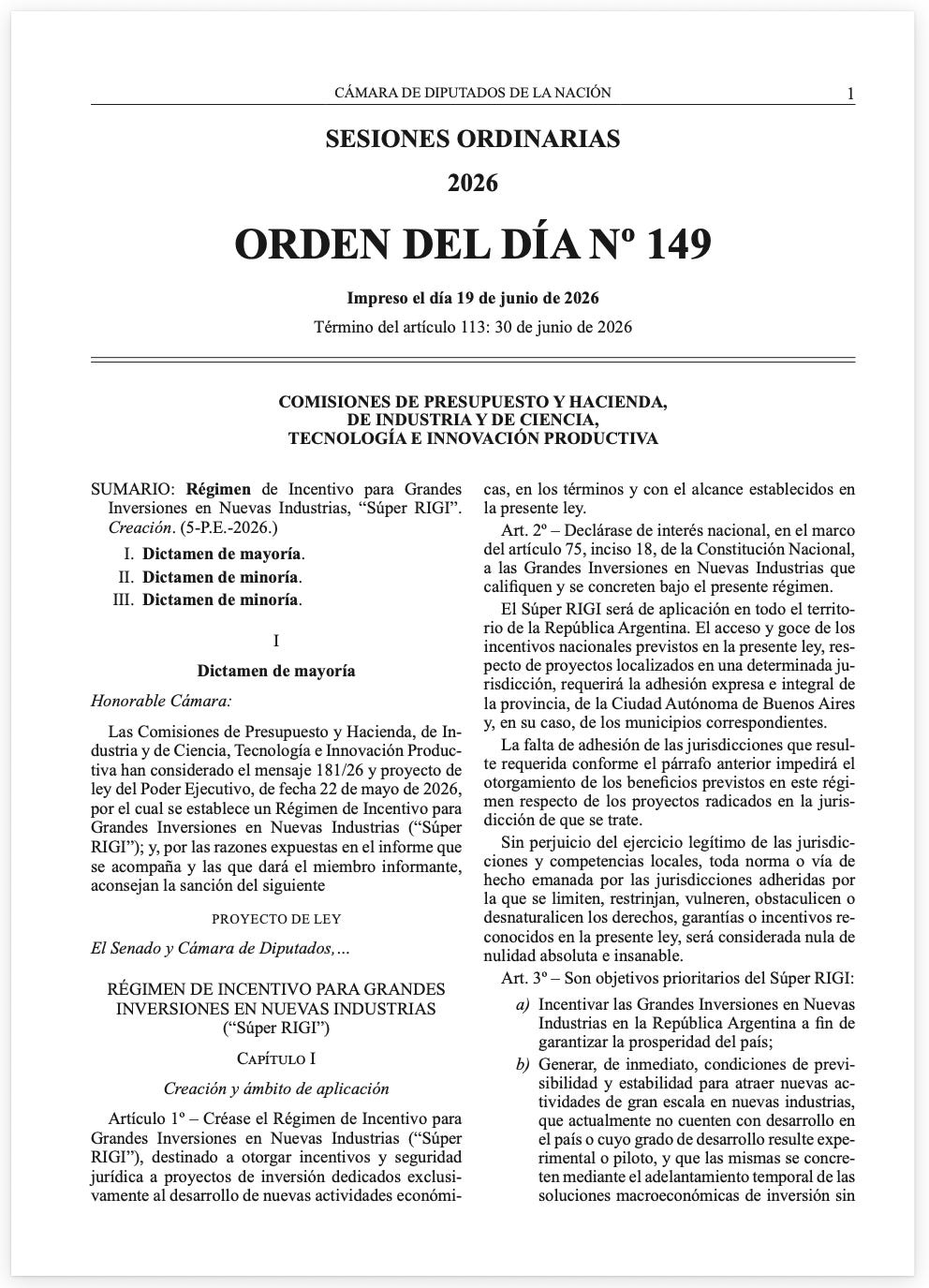
The text approved was not the draft the Executive proposed in May. It was the majority’s report (or dictamen), Orden del Día No. 149 (O.D. 149), signed in committee on June 17 and approved on the floor first in general and then article by article. My previous coverage analyzed the original submission. This article briefly reads the draft version that actually passed, against the instrument, to establish what changed.
What Survived in the New Version, and What Impacts Investors
The incentive core of the draft bill is intact. Corporate income tax remains fixed at 15% (Art. 34). The thirty-year stability guarantee over tax, customs, exchange, and social-security treatment survives unchanged (Art. 75). The staged export-liquidation relief keeps the same schedule (Art. 61). Dividends are taxed at 7% for four years and 3.5% after that (Arts. 40–41). Loss carryforwards remain unlimited and transferable to third parties after five years (Art. 38). The Pillar Two carve-out that deactivates the benefit where it would only feed a foreign treasury remains untouched (Art. 46). However, the Senate can still amend any of it.
Four New Modifications Add Compliance Obligations
The committee achieved its majority by adding a compliance layer, consisting of FOUR distinct items. (1) A local-supplier development plan is now mandatory, committing at least 20% of the amount destined to supplier payment to local providers, conditioned on those providers meeting market price and quality (Art. 17(o)). (2) Research-and-development (R&D) spending now counts double toward the billion-dollar threshold, but capped so that the doubling covers no more than 20% of the minimum (Art. 15). (3) The regulator must maintain a public, freely accessible registry of applications, approvals, sanctions, and withdrawals (Art. 114). And (4) the single one-year extension of the adhesion window is now conditioned on a published prior evaluation of the regime’s performance, rather than granted by decree alone (Art. 5).
Additionally, rejection grounds now include a substantial negative impact on the project’s area of influence (Art. 20(i)), backed by a sworn affidavit covering both natural-resource sustainability and local infrastructure capacity (Art. 17(j)).
Constitutional Objections on the Record
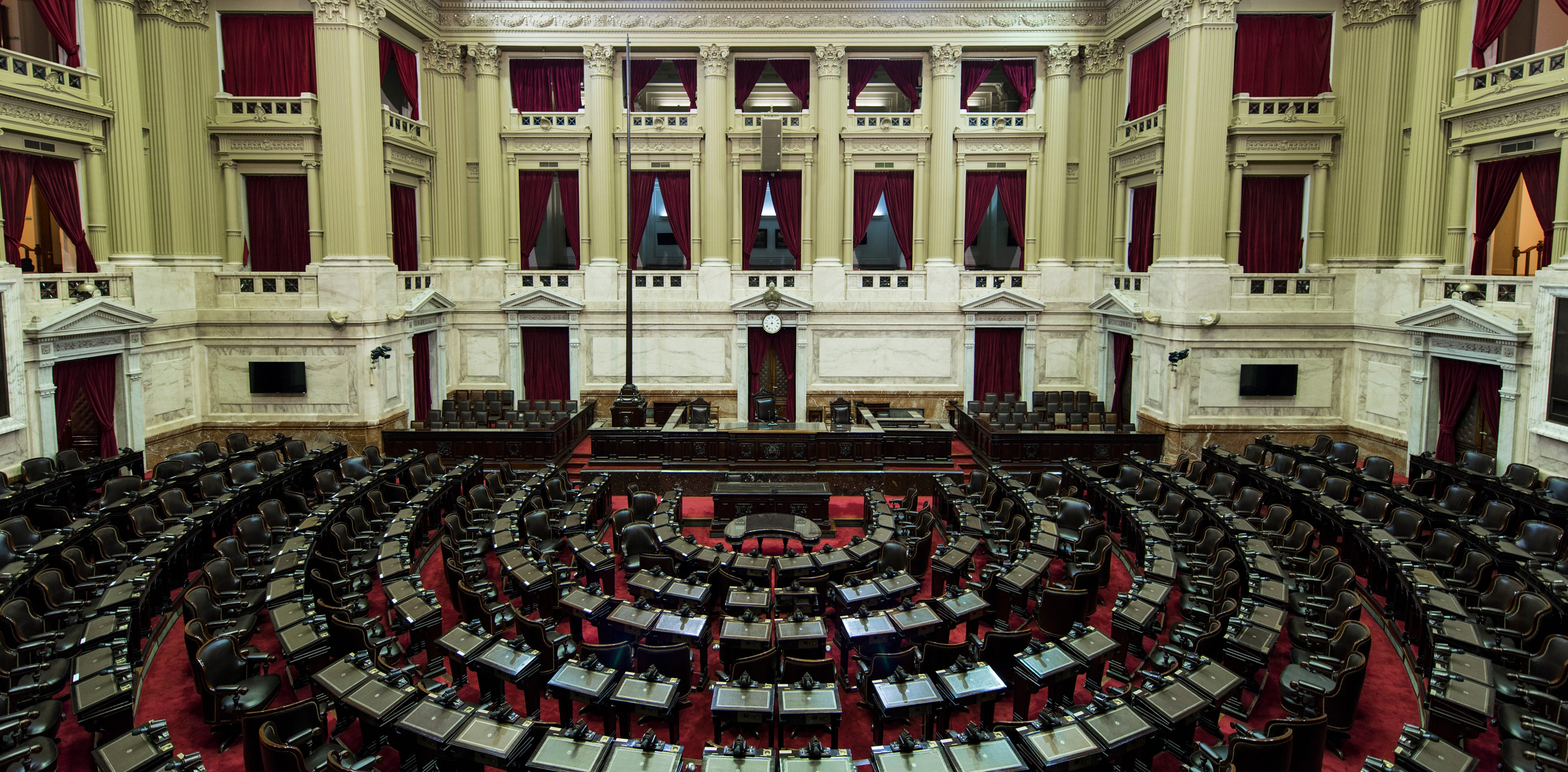
The floor debate predictably ran along partisan fault lines. La Libertad Avanza‘s Bertie Benegas Lynch, for the majority, argued that “capital has no homeland” and goes “where there is business and institutional security.” Unión por la Patria‘s Mario Manrique, for the minority, called it “a deal between private parties” rather than a law.
Specifically, the minority’s report argued that the Super RIGI invades powers the Constitution (CN) allocates to Congress, the provinces, and their municipalities. The Constitution’s Article 75 (1) and (2) give Congress exclusive power to legislate on customs and taxation, and the report treats the Super RIGI’s thirty-year stabilization clause as Congress renouncing that power in advance rather than exercising it. Likewise, CN Article 76 permits delegating legislative power to the Executive only within precise limits and a fixed term. Additionally, CN Article 123 protects municipal autonomy against exactly this kind of override of local tax, zoning, and environmental authority. Furthermore, CN Article 41 guarantees a healthy environment and a duty to preserve it for future generations, which the report argues the regime weakens by removing environmental-impact review, public participation, and the precautionary principle. And finally, CN Article 16’s equality clause, read with Article 75 (19)’s balanced-development mandate, is set against the territorial concentration of federal and private resources that the Super RIGI’s benefits scheme may create.
Importantly, the minority’s report asserts that the Argentinian Supreme Court has held that one legislature cannot bind its successors. This is in reference to the thirty-year tax stability clause in the Super RIGI. The minority argued that it is not “constitutionally reasonable” that, through a regime of “extraordinary stability that will last for decades”, the capacity of future generations of representatives of the Argentine people to legislate “should be limited”.
From a legal exposure standpoint, that thirty-year stability clause may be the item to watch for investors, given that the debate over it is now on congressional record.
Brief Political Analysis
The vote happened while then-Cabinet Chief Manuel Adorni faced an opposition censure drive over his legal woes. On June 23, a session called specifically to summon Adorni under CN Article 101 failed for lack of quorum. Congress wanted to depose Adorni on alleged illicit enrichment accusations.

On June 24, the opposition tried to bypass committee and force the summons directly onto the agenda, but fell short of the threshold again. By June 29, however, Adorni resigned from his post and then-Interior Minister Diego Santilli took his place as the new Cabinet Chief. This partially confirms what I pointed out in earlier analyses: the biggest hurdle in the way of the Súper RIGI was not necessarily the opposition’s case on the floor of the Congress. Rather, the biggest obstacle to passing the bill remains the discipline of the governing coalition.
Additionally, if the Super RIGI eventually passes the Senate, Art. 2 of the bill would withhold its benefits from any jurisdiction that hasn’t separately adhered. This is a decision that each province has to make on its own, regardless of how its deputies voted in Congress. Córdoba’s national deputies, for example, voted no to the bill. However, that vote doesn’t predict what Córdoba’s governor—or any other—does next, meaning that adhesion to the regime is a provincial decision alone, made later, on different terms than a floor vote. Catamarca did the opposite, abstaining rather than voting no, which may suggest that the province is positioning itself for the adhesion negotiation rather than for opposition to the regime per se. Córdoba has a robust auto-manufacturing and agro-export base, and Catamarca is part of the lithium and copper mining sector benefited by the original RIGI regime.

The Senate holds the timeline for passing the Super RIGI now. The government wants passage before the winter recess. A floor session is expected around mid-July, and the Super RIGI’s discussion is not scheduled in it. If the Senate votes in favor of the Chamber’s text unchanged, the regime clears its last legislative hurdle and moves to promulgation as law. If it amends even one article, the bill returns to the Chamber for a second reading, which would push enactment past the government’s own target.
Overall, the terms of the Super RIGI are close to settled but the calendar is not. The tax and FX package is likely to remain stable. However, the remaining variables will continue to be procedural and territorial. That is, the lingering questions are whether the Senate amends and sends the bill back, and which provinces adhere, since a project based in a non-adhering province cannot obtain the federal benefits in the Super RIGI at all.
What to Read Next:

Argentina's “Super RIGI”: A Quick Guide to the Proposed New Investment Regime for Foreign Investors


See The Southern Trade on Google
Want The Southern Trade analysis at the top of your feed? You can tell Google to prioritize this source by clicking on the button below.

© 2026 Manuel Reyes, The Southern Trade Group™. All rights reserved. Content may not be reproduced without permission.
Legal and Investment Disclaimer
This document is provided for informational and educational purposes only. Although it discusses legal frameworks, regulatory structures, and investment-related considerations, it does not constitute legal advice, tax advice, financial advice, or investment advice of any kind.
Nothing in this article is intended to create, and receipt of it does not constitute, an attorney-client relationship, advisory relationship, or any other form of professional engagement between the author and the reader. The content reflects a general overview and may not address specific facts, circumstances, or applicable laws relevant to any particular situation.
Readers should not act or refrain from acting based on any information contained herein without seeking independent advice from qualified legal, tax, and financial professionals licensed in the relevant jurisdictions.
This document does not constitute an offer to sell, a solicitation of an offer to buy, or a recommendation to purchase, sell, or otherwise trade any securities, financial instruments, or assets. Any references to investment structures, jurisdictions, or regulatory regimes are illustrative only and should not be interpreted as endorsements or recommendations.
The author makes no representations or warranties, express or implied, regarding the accuracy, completeness, or timeliness of the information contained herein. Laws, regulations, and policies may change, and their application can vary widely based on specific circumstances.
To the fullest extent permitted by law, the author disclaim any liability for any loss or damage arising directly or indirectly from reliance on this document or its contents.